
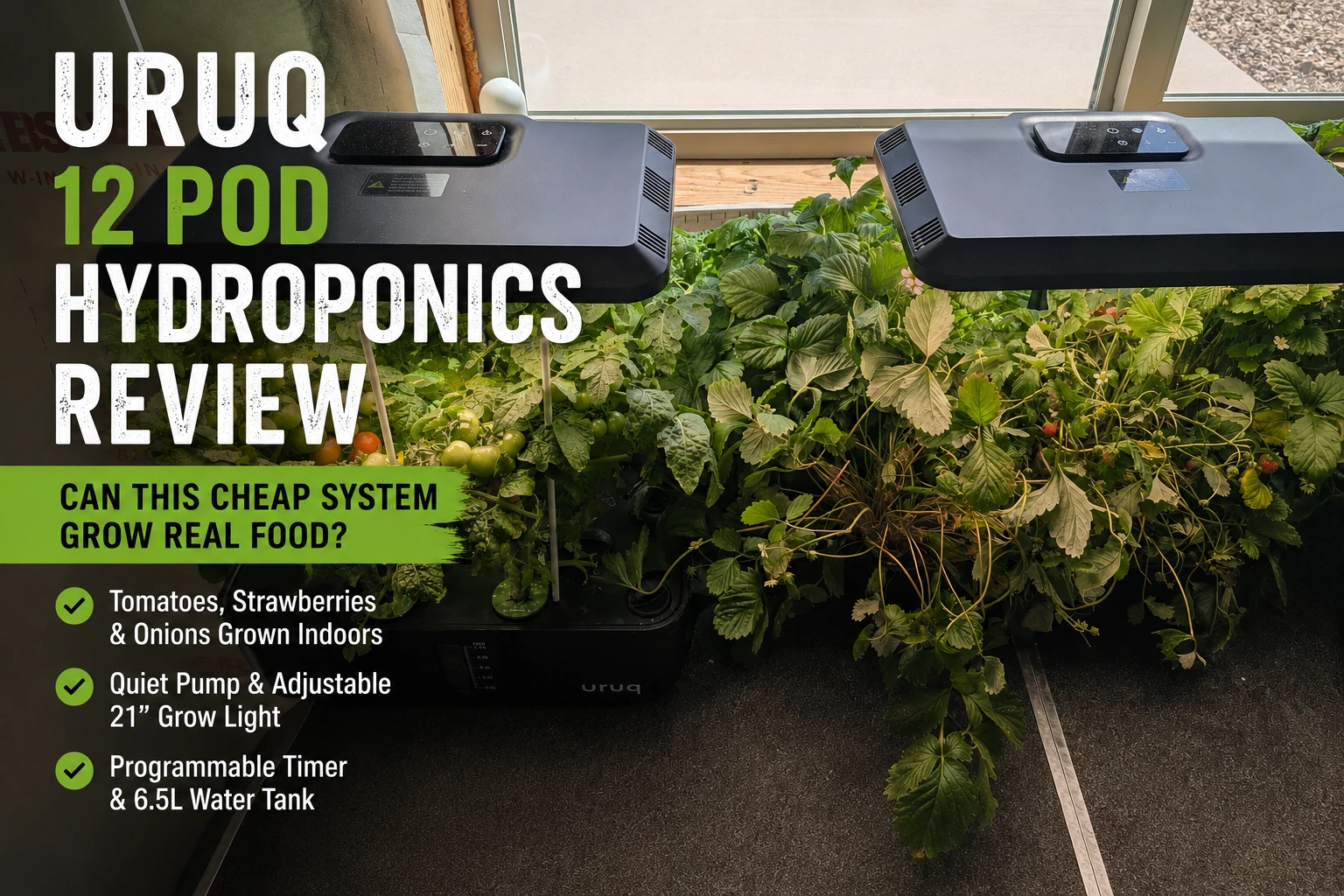
I’m extremely excited to finally share what I’ve been up to with hydroponics. I wanted to wait until I actually had real growth and harvests before writing anything because there’s no shortage of “day 1” hydroponics videos and reviews online.
So I decided to do something simple. I bought the absolute cheapest hydroponics kit I could find on Amazon and tried to grow real food in my basement.
The results have honestly been way more successful than I expected.
These URUQ systems were all under $50 and I now have multiple units running continuously producing tomatoes, strawberries, and onions indoors year-round.
This review is specifically about the URUQ 12 pod hydroponics system, although I also own the 8 pod version and there are some very important differences between the two.
What Did I Grow in the URUQ Hydroponics System?
For this review I grew:
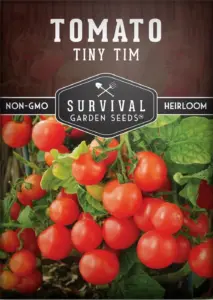


All three produced successful harvests so I’m comfortable sharing my long-term thoughts on the system now.
The seeds I used were from the popular SURVIVAL Garden Seeds lineup on Amazon.
My goal with hydroponics was pretty straightforward. I wanted fresh food growing continuously in my basement that we could actually eat regularly. Instead of starting with easy herbs or lettuce, I jumped straight into tomatoes, strawberries, and onions.
Probably not the easiest beginner crops.
But surprisingly, all three worked on the first attempt.
Is the URUQ 12 Pod Better Than the 8 Pod Version?
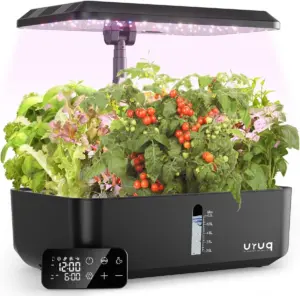
Yes. Absolutely.
I own both versions and there’s one major catch with the cheaper 8 pod unit.
The URUQ 12 pod hydroponics system comes with a detachable LCD controller that lets you schedule exactly when the lights turn on and off.
The 8 pod version cannot do this.
Instead, the 8 pod model simply runs on a fixed 16 hours on / 8 hours off cycle that starts the moment you plug it in.
That sounds minor until you actually use it.
If you wanted the lights to come on at 5 AM with the 8 pod version you would literally need to unplug and replug the system at 5 AM to reset the cycle. The 12 pod unit lets you schedule everything directly from the controller.
I strongly recommend the 12 pod version for this reason alone.
Oddly enough, the 12 pod version is often cheaper anyway depending on Amazon coupons and sales.
The water reservoir is another huge difference:
- 12 pod unit: 6.5L reservoir
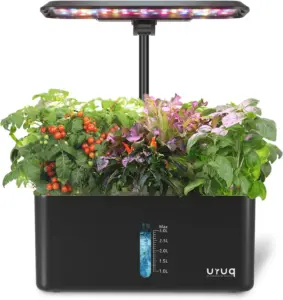
- 8 pod unit: 3L reservoir
If you’re growing larger plants like tomatoes, strawberries, or peppers, the extra water capacity matters a lot. Smaller reservoirs dry out surprisingly quickly once plants mature.
The 3L tank on the 8 pod unit leaves very little room for forgetting to refill the water.
If those caveats don’t bother you here is the 8 pod unit as well:
How Good Is the URUQ Grow Light?
Honestly, much better than I expected for the price.
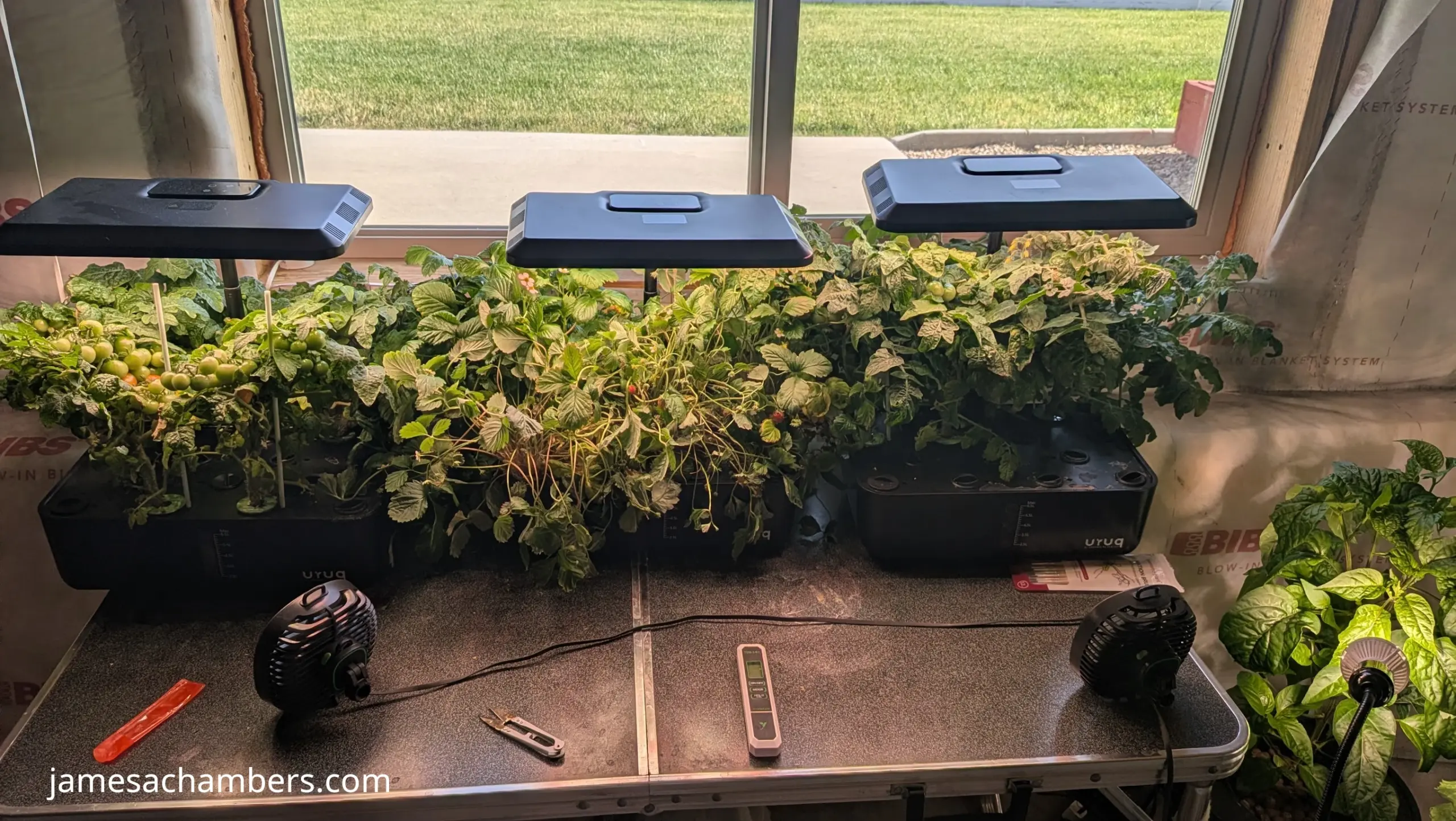
The grow light adjusts up to 21 inches high which was tall enough for my Tiny Tim tomatoes to mostly avoid smashing into the lights at full maturity.
In my pictures the lights are not even fully extended.
That’s important because a lot of cheap hydroponics systems have very limited vertical space and become unusable once plants start getting serious growth.
I also discovered something else while experimenting.
Supplemental light helps a lot.
One of my tomato units sits beside a window and you can literally see a second canopy of growth developing toward the natural light source.
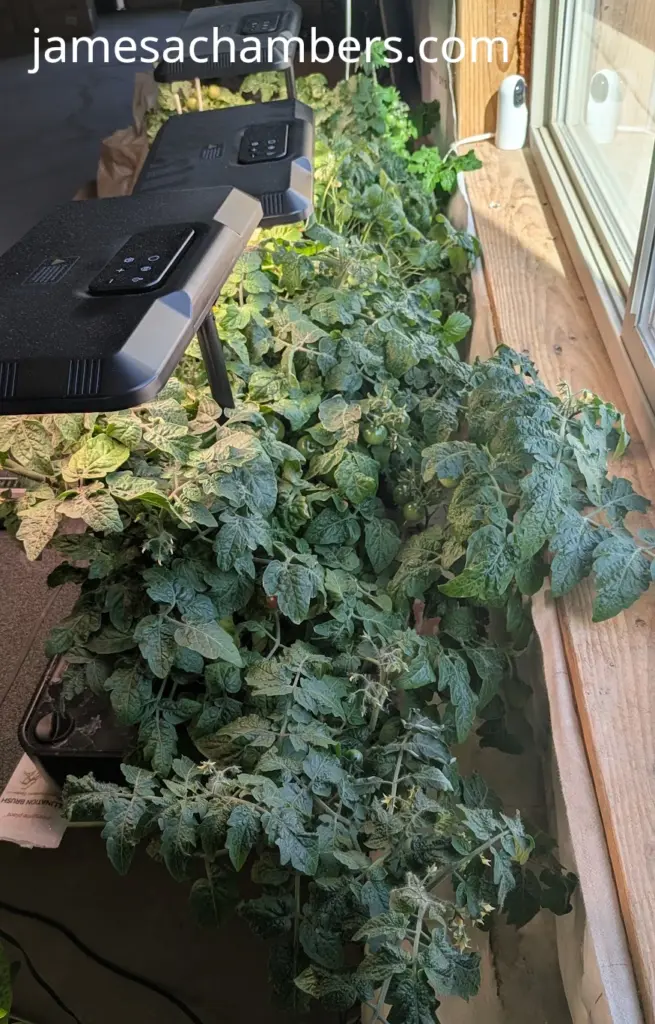
The yield is noticeably better. Do you see all the yellow flowers in the bottom right? Those will be additional tomatoes and you can see a giant cluster of tomatoes in the middle that would not exist without the supplemental light.
I took this shot in the evening so you can see that the light from the URUQ isn’t even hitting the back canopy. The back canopy is purely solar powered from the window.
The Alpine strawberries especially benefited from extra lighting. One of my strawberry units away from the window became much leggier compared to the unit near natural light:
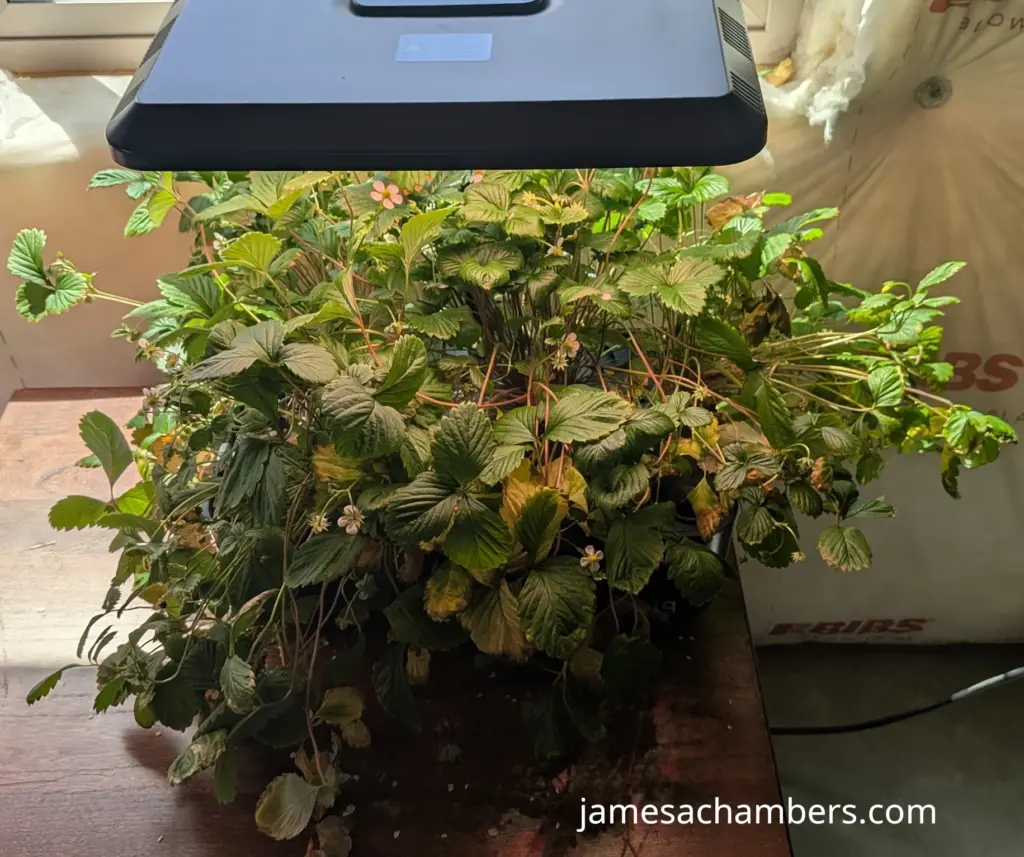
See how this one is not doing nearly as well as the other one? It still looks a little sickly but it is recovering and has produced a few strawberries.
The one that has been by the window the whole time though has produced like 40+ strawberries already.
If you’re trying to grow ambitious crops in a small hydroponics system, don’t be afraid to give them additional light.
Is the URUQ Hydroponics Pump Loud?
No. It’s extremely quiet.
The pump is rated at under 20dB and I believe it.
I currently have three units sitting right beside each other and the overall noise level is still very low.
The pump cycles:
- 30 minutes on
- 30 minutes off
Even in a basement living area the noise has never bothered me.
What Nutrients Come With the URUQ System?
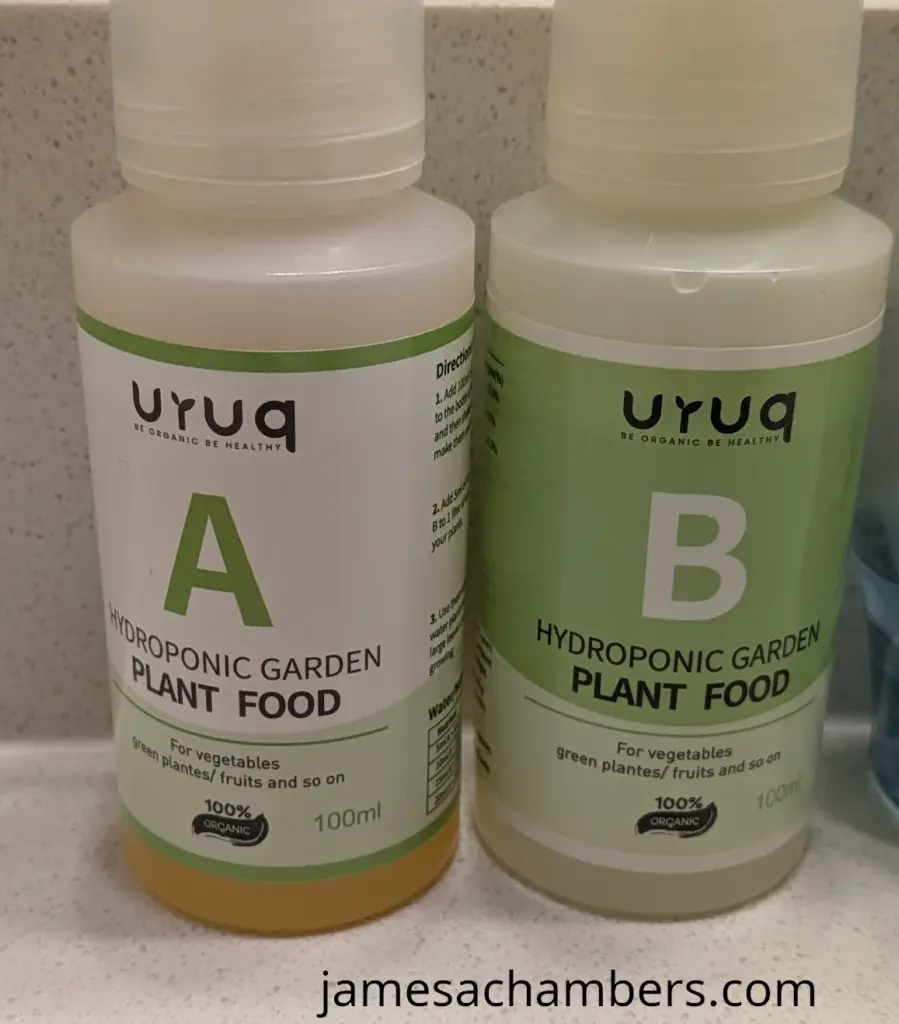
The unit includes hydroponic nutrients in standard “A” and “B” bottles along with dry refill packs.
If you’re new to hydroponics, the nutrients are separated for a reason.
When concentrated hydroponic nutrients are mixed together directly, solids begin precipitating out of solution. Once that happens, those nutrients become unavailable to the plants.
After dilution in water they are safe to combine.
My process is simple:
- Fill a 2L pitcher roughly 25% with water
- Add nutrient A
- Fill to around 50%
- Add nutrient B
- Fill the rest with water
The sink pressure mixes everything well enough.
The recommended dosage is:
- 5mL of nutrient A per liter
- 5mL of nutrient B per liter
What Mistakes Should Beginners Avoid With Hydroponics?
I made plenty.
Here are the biggest ones.
Should You Use Every Pod Slot?
No.
Definitely not.
I made this mistake immediately:
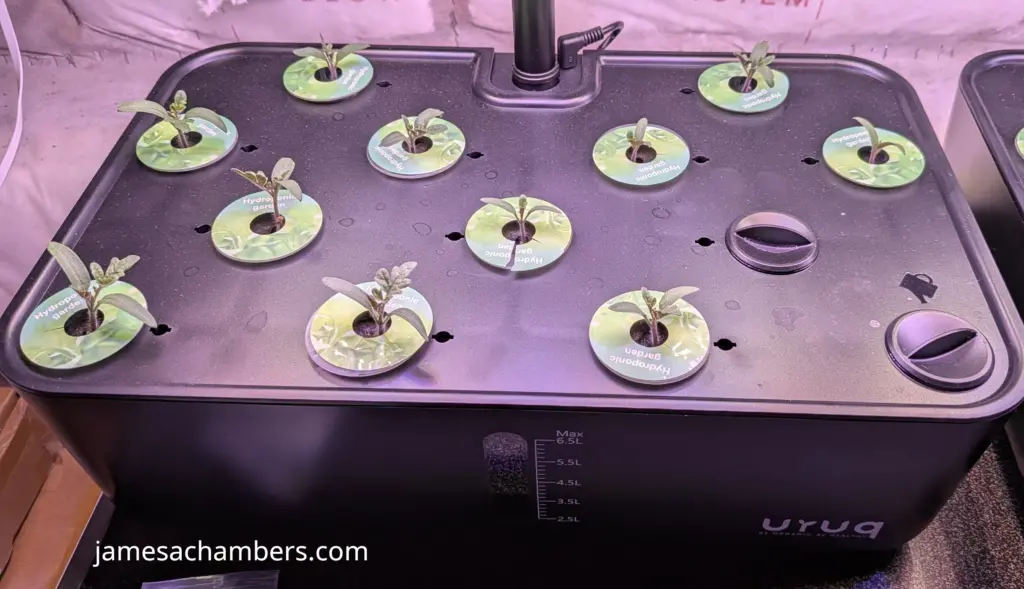
If you fully populate every pod, the roots become incredibly tangled and the plants compete aggressively for light and nutrients.
I ended up buying additional units just to split plants apart:
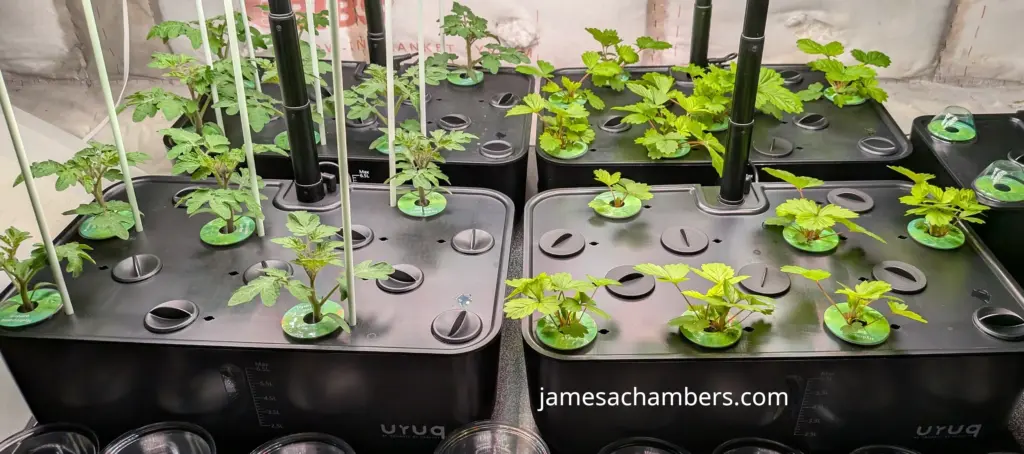
Did I mention I made the exact same mistake with the Alpine Strawberries? I did. Those are on the right and multiplied into two units as well.
Even then they were still overcrowded. I ended up transplanting several more from each unit into my outdoor garden.
Leaving empty pod spaces actually produces healthier plants and better yields.
Do You Need the Included Light Blocking Stickers?
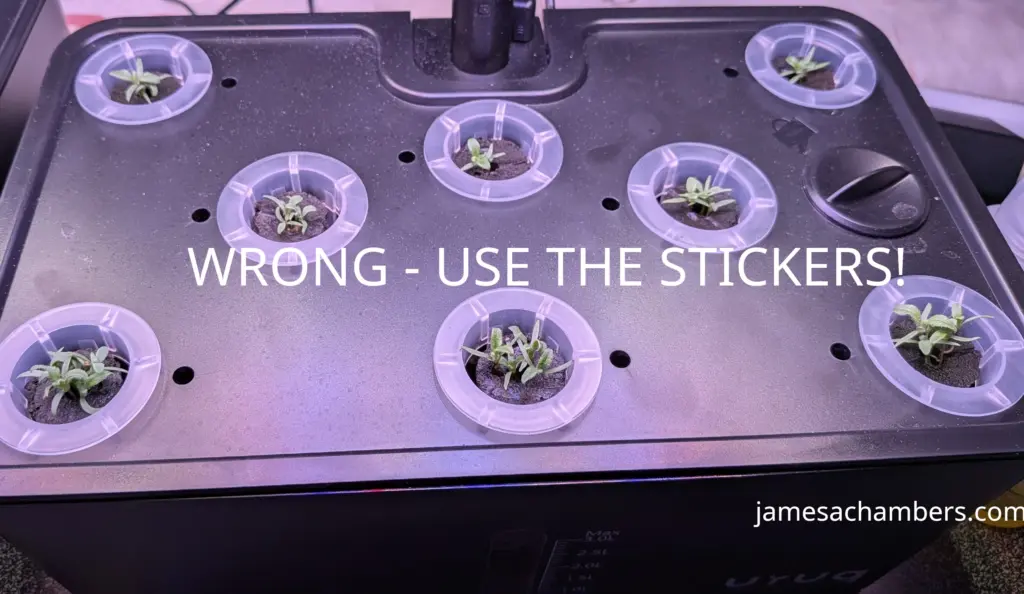
Yes. Use them.
The grow sponges are basically perfect algae-growing material if exposed to light.
Until the plants mature, light will hit the sponge directly and nasty green or brown algae starts forming quickly.
The included stickers solve this by blocking most of the light while leaving a small opening for the seedling.
They work very well.
Should Unused Hydroponic Holes Be Covered?
Absolutely.
If light reaches the water tank through unused pod holes, algae will eventually grow inside the reservoir.
You do not want this.
The units include a few hole covers and I eventually bought extra ones online for all my unused slots*.
It makes maintenance dramatically easier.
Which Plants Grew Best in the URUQ System?
The Tiny Tim tomatoes were by far the easiest.
They tolerated pH swings well, handled varying EC levels without complaint, and consumed enough water that nutrient concentration stayed relatively stable.
Mine drink roughly 1 liter of water per day.
The Alpine strawberries were more demanding.
Their EC levels climbed much faster which meant I needed full water changes more frequently. If you neglect water maintenance with strawberries, you will eventually run into nutrient imbalance problems.
The Tokyo White bunching onions have been extremely easy so far and use very little water:
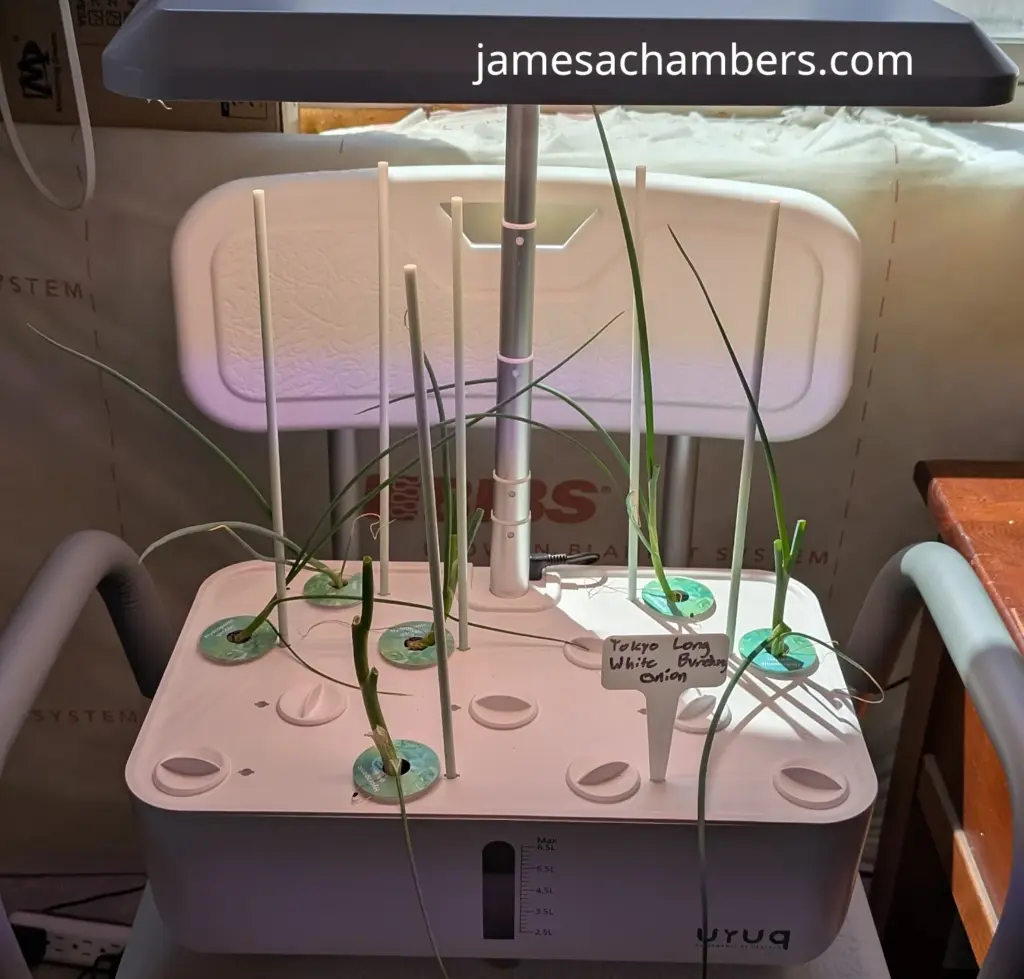
They’re also one of the most rewarding crops because they’re essentially “cut and come again.” We simply trim the green shoots and they continue regrowing.
Do You Really Need pH and EC Meters for Hydroponics?
Yes. Even for beginners.
I strongly recommend getting both.
At some point during your grow, your plants are probably going to start looking unhealthy for one reason or another.
Without pH and EC tools you’re mostly guessing.
I use a VIVOSUN pH and EC combo meter* and it works great with one minor issue: the URUQ holes are narrow enough that the tank needs to be pretty full to comfortably take readings:
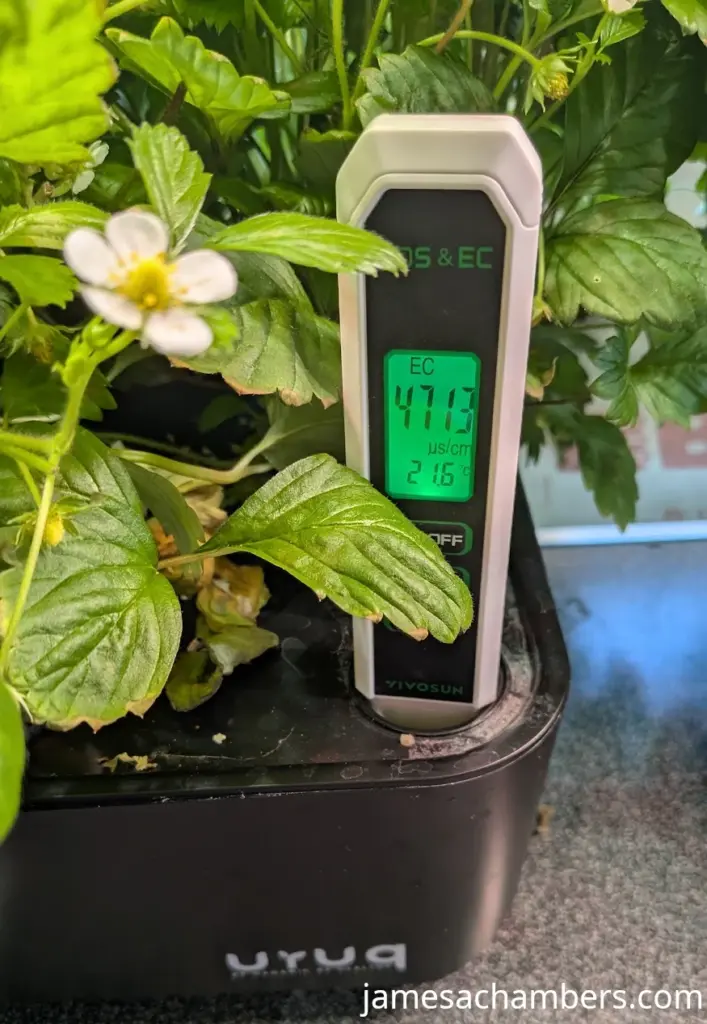
One important thing I learned:
If you refill the reservoir before testing, let the water sit for at least 30 to 60 minutes before taking readings. Freshly added water will not be fully mixed and your measurements can be inaccurate.
If you don’t have these meters and your plants aren’t doing well then a water change is probably in order. Without the meters though you won’t be sure what the pH is of the water you are adding in. Using distilled water is the safest in this case as the pH will be okay for hydroponics from distilled water from the store.
What Is the Best Water for Hydroponics?
This is probably the single biggest factor in successful hydroponics.
Distilled water is considered ideal.
I do not use distilled water.
Realistically, with multiple systems running I would need an absurd amount every week.
Instead I use tap water, but this comes with caveats.
You absolutely need to understand your water quality.
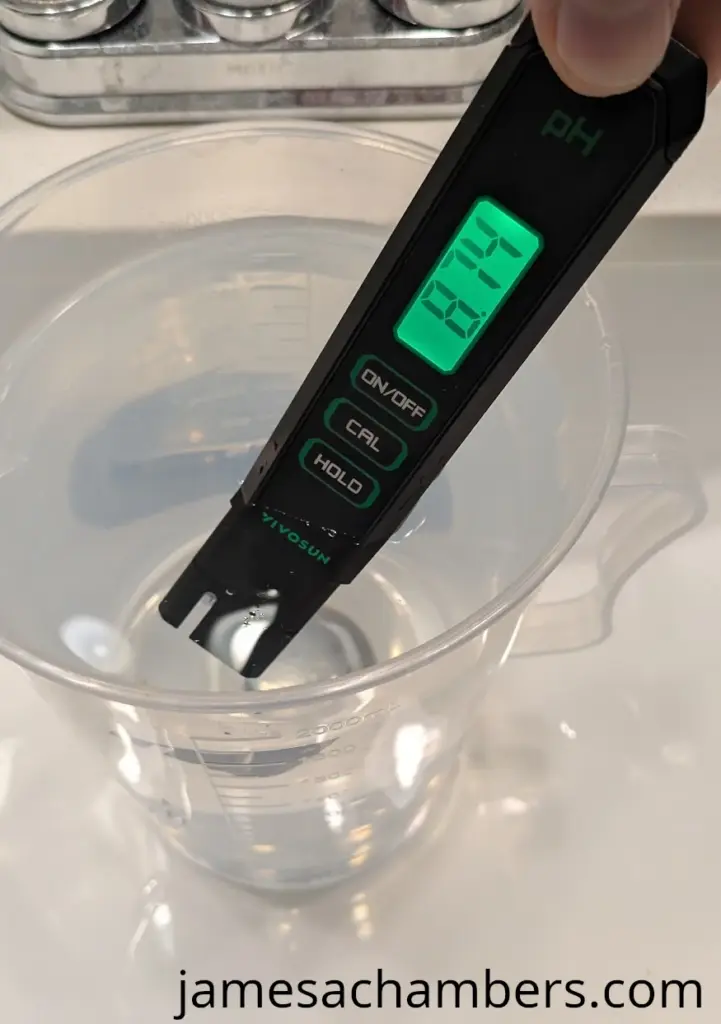
My tap water has a pH ranging from 8 to 8.75 which is very alkaline for hydroponics. For reference the generally recommended range is usually 5.5 – 6.5 pH for hydroponics.
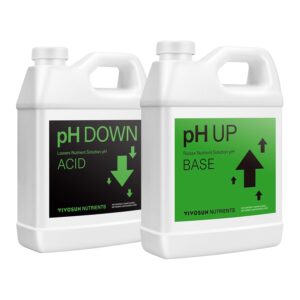
Because of this, I add some of VIVISUN’s pH down* (just a little bit, no more than a couple mL) to every single pitcher of water before adding it to the system.
I also add a small amount of hydrogen peroxide:
- A few mL of 3%
- Or about 1mL of 12% hydrogen peroxide per 2L pitcher
This helps suppress algae and root rot without harming the plants at low concentrations.
Can Tap Water Cause Nutrient Lockout?
Definitely.
I experienced nutrient lockout multiple times before I understood what was happening.
Some of the harvests shown here probably would have matured nearly a month earlier if my pH had stayed under control consistently.
Once I started adjusting every refill with pH down, the growth improved dramatically.
Softened water can also cause issues because dissolved salts build up in the system over time.
If your water quality is poor, reverse osmosis water is probably the better long-term solution.
I haven’t added an RO system yet, but I likely will eventually because I’m currently using a lot of additives just to compensate for my local water.
The cleaner your source water is, the easier hydroponics becomes.
Is Growing Food Indoors Actually Worth It?
For me, yes.
Completely.
We’ve already made:
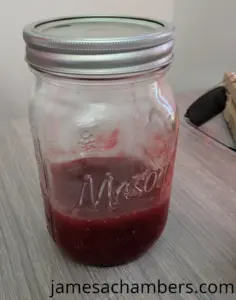
This is strawberry jam from the Alpine strawberries. My wife’s breadmaker* had a setting to make jam and we tried it to great success!
We are collecting the Tiny Tim to make into a home made pizza sauce:

We’ve also been using the fresh onions for cooking for weeks now.
The Alpine strawberries especially surprised me.
If you’ve never tried Alpine strawberries before, they’re incredibly aromatic compared to normal strawberries. They don’t ship well commercially which is why most people never encounter them:
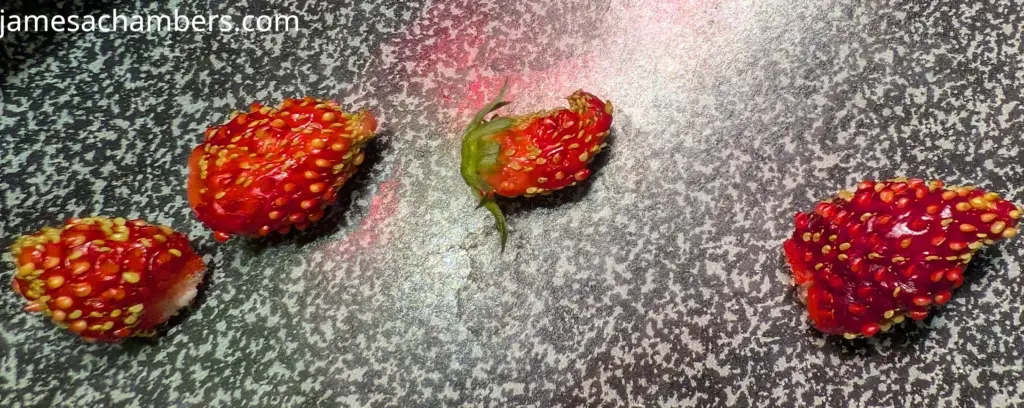
Fresh off the plant they smell almost unreal.
The onions were another surprise. They’re much stronger and more flavorful than store-bought green onions.
Would I Recommend the URUQ 12 Pod Hydroponics System?
Yes. Especially for the price.
This is one of the cheapest hydroponics systems I could find online and it has massively exceeded my expectations.
Are there limitations? Of course.
You still need to learn basic hydroponic maintenance, monitor water quality, and avoid overcrowding the plants.
But the actual hardware itself has been reliable, quiet, easy to maintain, and surprisingly capable.
The biggest recommendation I can make is simple:
Buy the 12 pod version* instead of the 8 pod version*.
The programmable lighting schedule and larger reservoir are absolutely worth it.
I also have several larger hydroponics systems running now that I’ll be reviewing later where we grow lettuce, salad greens, and more.
I’m definitely still learning as I go and I’m not pretending to be an expert. I’m mostly sharing what has worked for me so far, including the mistakes.
If you’ve done your own hydroponic grows or have any tips, let me know in the comments.
FAQ
Is the URUQ 12 pod hydroponics system good for beginners?
Yes. It’s one of the easiest and cheapest ways to get started with hydroponics indoors. The system is simple to assemble and maintain while still being capable of growing real food like tomatoes and strawberries.
What can you grow in the URUQ hydroponics system?
You can grow herbs, lettuce, tomatoes, strawberries, peppers, onions, and other compact crops. I successfully grew Tiny Tim tomatoes, Alpine strawberries, and Tokyo White bunching onions.
How often do you change the water in the URUQ hydroponics system?
Ideally every couple of weeks. Fast-feeding plants like strawberries may require more frequent water changes because EC and salt buildup can happen quickly.
Does the URUQ hydroponics system need pH testing?
I strongly recommend it. While the system can work without testing initially, pH problems and nutrient lockout become much harder to diagnose without a pH and EC meter.
Is the URUQ 12 pod better than the 8 pod version?
Yes. The 12 pod version includes programmable lighting controls and a much larger 6.5L reservoir. The 8 pod version lacks customizable scheduling and has a much smaller water tank.


This is a really useful hands-on review of the URUQ hydroponics system. I especially liked the points about avoiding overcrowding and keeping an eye on water quality. The real growing results with tomatoes, strawberries, and onions make the review much more helpful and practical. Great insights!